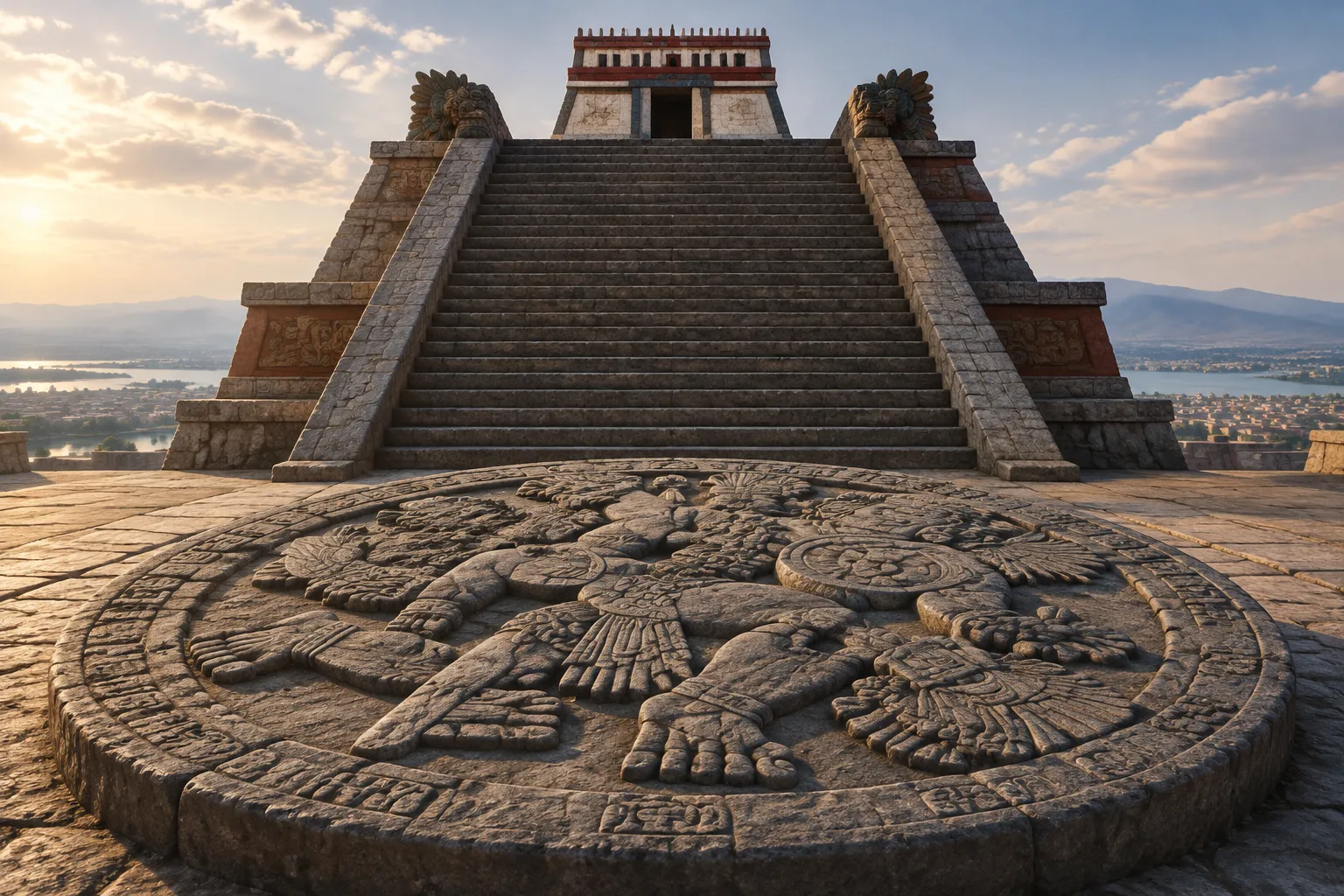
Why place the image of a defeated goddess at the bottom of a temple staircase? At the Mexica capital of Tenochtitlan, Coyolxauhqui’s position was part of her meaning. The stone belonged below the ascent toward Huitzilopochtli’s sanctuary, not in an interchangeable spot within the sacred precinct. Read together, sculpture and staircase made a relationship visible: the defeated figure below, the victorious deity above. INAH’s archaeological guide to the Templo Mayor identifies this southern half of the building with Coatepec, the sacred mountain of Huitzilopochtli’s birth.
That connection offers a precise way into Mexica sacred art. Rather than treating the relief as an isolated illustration, we can ask what its location added to the story—and what the different kinds of surviving evidence actually allow us to say.
1. A sacred mountain inside Tenochtitlan
The Templo Mayor had paired sanctuaries: Tlaloc’s on the north and Huitzilopochtli’s on the south. INAH explains these as two sacred mountains represented within one building, with Coatepec on Huitzilopochtli’s side. Its guide places the Coyolxauhqui monument beside the discussion of construction stage IVb, associated with Axayacatl’s reign, 1469–1481. It also distinguishes the replica at the staircase from the original sculpture. These details anchor the question in a particular Mexica setting rather than an undifferentiated “Aztec world.”
The architectural relationship matters more than the general observation that a temple contained religious sculpture. A picture can tell us who appears in a story. Placement can tell us how that figure relates to a sacred destination. Here, looking upward from Coyolxauhqui’s position means looking toward her opponent’s sanctuary. That is an interpretation of the arrangement, but one grounded in the identification of the southern temple with Coatepec.
2. The written story is a later witness
Our textual witness here is Book 3 of Bernardino de Sahagun’s sixteenth-century work, presented in a UC San Diego bilingual reading using Arthur J. O. Anderson and Charles E. Dibble’s English translation. It is a colonial-era record, not a surviving preconquest caption for the stone. The teaching page also contains modern headings and commentary, which should not be confused with the translated Nahuatl passage.
In that account, Coatlicue conceives after gathering a descending ball of feathers while sweeping at Coatepec. Coyolxauhqui urges the Centzon Huitznahua to kill their mother. Cuahuitlicac reports their approach to the unborn Huitzilopochtli. The deity emerges armed, defeats Coyolxauhqui, and her severed body falls down the mountain.
This distinction between object and text is essential. The stone is precolonial material evidence; the account records a narrative in a colonial textual setting. Their correspondence is powerful, but it does not make them identical witnesses. We should not assume that every detail preserved in writing was carved into the relief, or that every viewer supplied precisely the same version of the narrative.
3. Why the bottom of the stairs matters
The most revealing correspondence is spatial. In the translated narrative, Coyolxauhqui’s body falls below after her defeat. At the temple, her image occupied the foot of the ascent associated with Huitzilopochtli. The story and the building share a vertical relationship. This is the central reason to read the monument in its architectural setting rather than only as a photograph of a circular sculpture.
Think of the difference between a scene and a setting. A scene fixes an episode for inspection. A setting places the observer in relation to it. On this reading, the staircase extended the significance of the relief beyond its carved surface: the mountain of the narrative could be understood through the built ascent. The observer did not need to see a carved representation of the whole mountain, because the temple supplied that dimension.
This does not mean the building was merely a giant illustration. “Illustration” can imply something secondary, added to explain a text. The archaeological evidence deserves equal attention. Sculpture and architecture could express a relationship in their own right; the later written narrative helps us recognize it without exhausting its possible significance.
4. Gold ornaments reveal a second scale of sacred imagery
Coyolxauhqui’s imagery was not confined to the monumental relief. The Metropolitan Museum’s record for a pair of Mexica gold ear ornaments from Tenochtitlan, dated 1486–1502, discusses ornaments excavated at the Templo Mayor and associated with her. Its Spanish description connects characteristic ear ornaments with the tail of Xiuhcoatl, the mythic fire serpent, and pear-shaped bells with the goddess’s cheeks. It also notes accompanying obsidian projectile points and flint knives.
The contrast in scale is instructive. An enormous architectural arrangement and small pieces of gold need not do the same work. One organizes an encounter with a sacred place; the other carries identifying forms through precious material and carefully shaped details. Their shared association with Coyolxauhqui suggests a useful interpretive question: how could recognition persist when size, material, and setting changed?
That question is more productive than assuming the ornaments belonged to the stone figure, or that they were everyday jewelry worn by a particular person. The museum record establishes an association, not those further claims. It reminds us to distinguish an object’s documented context from an appealing reconstruction.
5. A defeated goddess and the language of power
The Met interprets Coyolxauhqui both cosmologically, through a struggle between moon and sun, and politically, as a vanquished enemy warning those who challenged Mexica power. Those are museum interpretations, not words spoken by the stone. The distinction matters especially with the familiar label “moon goddess”: a celestial identification can guide a reading without replacing the particular family conflict and mountain setting preserved in the narrative.
The political reading also changes the question we ask. Instead of wondering only what happened to Coyolxauhqui, we can consider what a victorious deity’s community communicated by preserving her defeat so prominently. In this interpretation, the image makes victory enduring and visible. That is a reading of power expressed through placement, not evidence that every spectator responded alike.
For a broader discussion of sacred visual language, see our article on symbols in Aztec philosophical discourse. Coyolxauhqui offers a concrete case in which interpretation should begin with location and material context.
The answer to the opening question is therefore architectural as well as narrative. Below Huitzilopochtli’s sanctuary, Coyolxauhqui occupied the position her defeat required. The staircase made the relationship legible. Reading it carefully means holding three things together without collapsing them: a precolonial monument, a colonial Nahuatl account, and modern interpretations that connect the surviving evidence.
Sources and further reading
- Sahagun, Book 3: bilingual Nahuatl reading with Anderson and Dibble’s translation, presented by David K. Jordan, UC San Diego.
- Templo Mayor archaeological guide, INAH: temple layout, construction stages, and sculpture locations.
- Pair of Ear Ornaments, Metropolitan Museum of Art: Mexica gold ornaments and Coyolxauhqui’s imagery.


