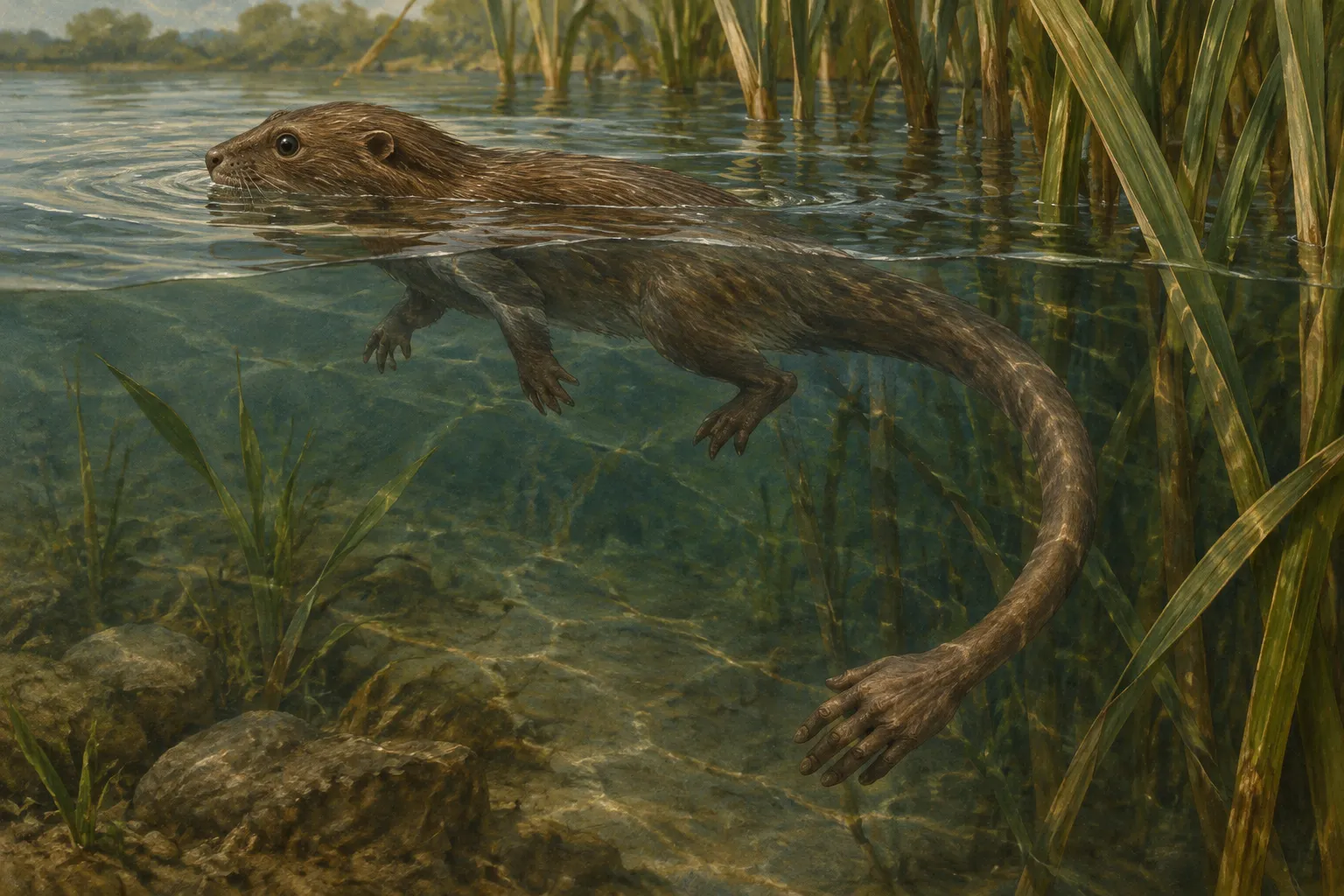
A man struggles in deep water, still clutching his paddle. Nearby swims a small brown animal with four legs and a long tail. The creature is not enormous, and its appearance is surprisingly calm. Yet it holds the advantage: according to the story accompanying this image, its tail ends in a hand capable of dragging a person underwater. This encounter appears in Book 11 of the Florentine Codex, folio 71r.
The animal is the ahuitzotl, also written ahuizotl. Why give a water creature a humanlike hand? The surviving evidence cannot supply an original designer’s explanation. It does, however, suggest a compelling reading: the hand makes the ahuitzotl more than something dangerous to meet. It makes it an active captor, reversing the familiar relationship between people and animals.
A colonial witness, not an untouched window
The starting point is a particular document, not a single timeless account of everything Aztec people believed. The University of Oregon’s Visual Lexicon identifies this illustration as part of the Florentine Codex, dated 1577 and associated with Mexico City. Its commentary places the encounter within a longer account extending across several manuscript pages. We are therefore reading colonial-period evidence for a Nahua tradition, rather than a surviving preconquest explanation written alongside the image. The lexicon’s manuscript identification and commentary establish those limits.
That distinction matters when asking what the creature meant. A manuscript image can preserve an older tradition while also expressing the circumstances in which it was painted. We should neither dismiss it because it is colonial nor treat every visible detail as an unchanged survival from before the conquest.
It also helps to separate three questions. What does this particular picture show? What do historical texts say about the word ahuitzotl? And how have modern scholars interpreted the creature? The answers overlap, but they are not interchangeable. A dictionary definition cannot explain every feature of a painting, and a modern interpretation should not be presented as an ancient quotation.
The little animal that becomes the hunter
In Stephanie Wood’s description of folio 71r, the man has fallen from his canoe. His raised arm and open mouth suggest a call for help. The ahuitzotl occupies the other side of the scene, apparently untroubled. Wood identifies the underlying reversal explicitly: this is an animal hunting people rather than a person hunting animals. Her reading of the drowning scene makes its unusual balance of power clear.
The tail-hand is central to that reversal. Read as a visual device, it supplies the creature with the means to seize rather than merely bite. The danger comes from being grasped and pulled somewhere a human cannot remain alive. The hand extends the animal’s reach while giving its action an unsettling resemblance to purposeful human capture.
This is an interpretation of the feature, not a recovered Nahua explanation of its origin. Nevertheless, it follows the action described in the source more closely than treating the hand as decorative fantasy. Remove it, and the picture becomes an encounter with an aquatic animal. Keep it, and the creature can take hold of the person whose paddle no longer guarantees control.
The contrast between the man’s distress and the animal’s composure sharpens the effect. The ahuitzotl does not need a gigantic body to dominate the encounter. In this reading, its power lies in possessing precisely the ability the swimmer cannot counter.
Why “water dog” is not a complete answer
A different witness offers a much shorter description. Alonso de Molina’s 1571 vocabulary defines auitzotl as a small water animal resembling a little dog, according to the transcription preserved in the Online Nahuatl Dictionary. That is useful evidence for how the word was explained in a sixteenth-century lexicon. It is not, by itself, a full account of the creature’s narrative identity.
The difference is worth lingering over. “Resembling a little dog” describes an appearance through comparison. It does not necessarily mean that every account understood the animal as a domestic dog living underwater. Nor does a compact vocabulary entry have to reproduce everything a longer narrative says.
Etnohistorian Yuri Escalante Betancourt likewise warns against settling the question through resemblance alone. In his discussion of the ahuitzotl’s animal forms, he considers dog, otter, and opossum associations without identifying the legendary being conclusively with any one species. He follows a proposed translation meaning approximately “spiny one of the water,” rather than simply treating “water dog” as an unquestionable literal equivalent.
The reader’s payoff is not a solved zoological mystery. It is a better question. Instead of asking which ordinary animal the story supposedly misidentified, we can ask what its combined features allow it to do. The humanlike hand then becomes evidence to interpret, not an inconvenient detail to explain away.
A captured creature complicates the story
The drowning scene is not the only encounter in this manuscript sequence. Wood’s commentary also summarizes an episode on folio 73r: a woman captures an ahuitzotl, places it in a water jar, and takes it to local lords. They recognize it as teotl, which the commentary renders as a divine force. The account of the woman and the jar complicates any simple picture of an unbeatable predator.
Here, the direction of capture changes again. A human contains the being that elsewhere takes humans underwater. Yet physical possession does not settle its identity. The decisive moment is recognition: what has been brought before the lords is understood as more than an unfamiliar specimen.
We should resist filling the gaps in this summary. It does not authorize an invented conversation, a motive for the woman’s actions, or a general rule that anyone could safely catch the creature. What it does permit is a narrower observation: the manuscript tradition makes room for both human vulnerability and human capture, without reducing the ahuitzotl to an ordinary captive animal.
Readers interested in the terminology can continue with this site’s discussion of the concept of teotl in Aztec thought. In this episode, the important point is the act of recognizing divine significance, not assigning the creature a modern biological category.
A hand, a royal name, and the limits of certainty
The same name also belonged to a historical ruler. The Online Nahuatl Dictionary collects annalistic passages recording Ahuitzotzin’s installation in 1486 and death in 1502. These attestations concern the ruler of Tenochtitlan, not another episode in the animal’s adventures. The dictionary’s dated historical examples help keep those uses distinct.
Escalante’s article describes a monument from Tepoztlan, Morelos, bearing the ruler’s name sign: a quadruped with water imagery on its back and a human hand at the tail’s end. The extraordinary appendage therefore appears in a different setting from the drowning narrative. Here it helps identify a royal name. The monument’s caption and accompanying analysis show why context matters when interpreting the figure.
A name sign is not automatically a complete illustration of a myth. Equally, recognizing a royal association does not erase the creature’s narrative life. Keeping those functions separate lets the evidence remain richer than a single label.
Why, then, did the ahuitzotl have a hand on its tail? No source used here preserves a definitive origin explanation. The strongest reading is functional: the hand makes capture visible. In the drowning scene, the person with a paddle loses command, while the small animal possesses the reach to seize him. The disturbing feature is not simply that the creature looks partly human. It is that, beneath the water, it can act like the hunter.
Sources and further reading
- Stephanie Wood, “ahuitzotl (FCbk11f71r),” Visual Lexicon of Aztec Hieroglyphs — commentary on the manuscript image and related episodes.
- Yuri Escalante Betancourt, “El ahuítzotl. Animal asesino del agua,” Arqueología Mexicana — accessible excerpt on animal identifications, naming, and iconography.
- “ahuitzotl,” Online Nahuatl Dictionary — Molina’s vocabulary entry and dated historical attestations.


